
Job Costing
Job Costing
Did That Job Actually Make Money? The Profitability Question Every Fabricator Needs to Answer
Did That Job Actually Make Money? The Profitability Question Every Fabricator Needs to Answer
Did That Job Actually Make Money? The Profitability Question Every Fabricator Needs to Answer

By
By
By
Matthew Quigley
Matthew Quigley
Matthew Quigley
All field notes
All field notes

At a glance
A busy shop is not always a profitable shop. Margin can disappear through rework, underestimated setup time, material waste, overtime, machine downtime, outside process delays, and unclear change control. The key question is not just “did we invoice the job?” It is “did we actually make money?”
Revenue can hide a lot of problems in a fabrication shop.
The shop can be busy. The machines can be running. The team can be working overtime. The invoice can go out. The customer can be happy.
And the job can still lose money.
That is the uncomfortable truth behind job-level profitability. In custom fabrication, quoted margin and actual margin are not the same thing. The quote is a plan. The job is reality. Between those two points, a lot can change.
A job that looked profitable when it was accepted can lose margin through extra setup time, rework, material waste, labour overruns, supplier delays, overtime, missed change charges, or outside processes that cost more than expected. If the business only discovers that after invoicing, it is too late to do anything about it.
The owner may know the business is busy, but still not know which jobs are genuinely worth winning again.
A full workshop can still be leaking margin one job at a time.
Why job profitability is hard to see
In many fabrication shops, profitability is measured at business level rather than job level. The owner reviews monthly revenue, expenses, payroll, materials, overheads, and cash flow. That gives a picture of the business overall, but it often does not explain which jobs are helping and which jobs are hurting.
The problem is that job costs are created across multiple places. The quote may sit in a spreadsheet. The schedule may sit on a whiteboard. Material purchases may sit in emails or accounting software. Labour time may be estimated rather than captured. Rework may be known by the supervisor but never recorded properly. Outside process costs may arrive later. The invoice may go out without a full review of what actually happened.
By the time the owner sees the financial result, the operational causes are hard to reconstruct.
That is why many shops rely on gut feel. They know certain customers are difficult. They know certain job types always seem to run over. They know some work looks good but causes stress. But unless the data connects quote, production, materials, labour, and invoice, it is hard to prove.
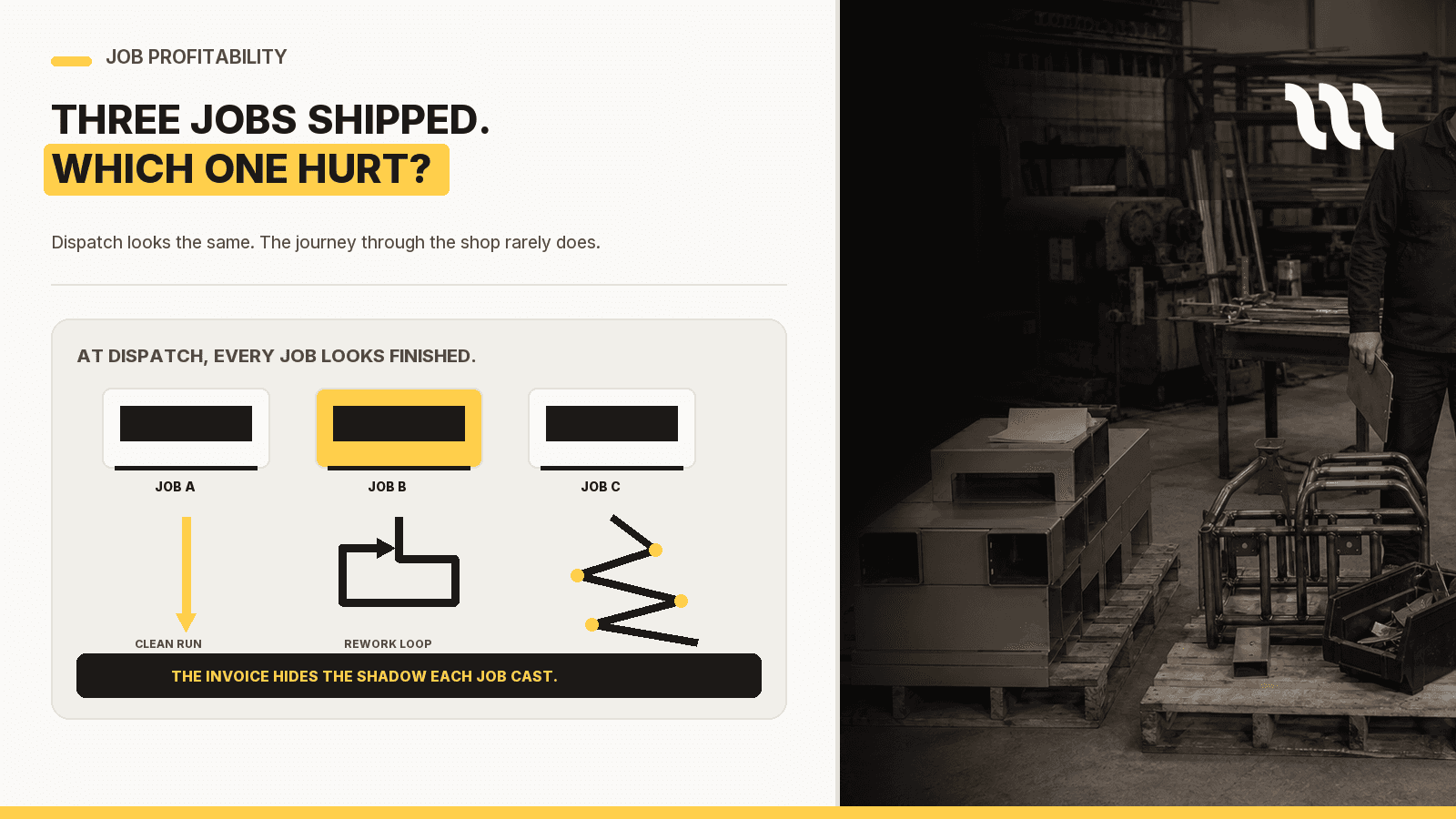
The quote is only the starting point
A quote is not proof of profitability. It is an estimate based on what the business believed at the time.
That estimate may be good. It may be based on experience, previous work, supplier pricing, and careful judgement. But it is still an estimate.
The job only becomes real once it hits production. That is when assumptions are tested. Did the material arrive at the expected cost? Did the machine time match the estimate? Did setup take longer? Did the operator need clarification? Did the job flow smoothly between operations? Did the customer request a change? Did delivery require overtime?
If the business does not capture those differences, the quote never improves. The same mistakes repeat. The same low-margin work gets won again. The same customers consume more effort than expected.
A better profitability process compares quoted assumptions with actual performance. Not to blame people, but to improve the next decision.
The most dangerous jobs are not always obvious
Some unprofitable jobs are obvious. They go wrong, cause stress, miss the delivery date, require rework, and everyone knows they were painful.
The more dangerous jobs are the ones that look fine.
They move through the shop without major drama. The customer pays. The invoice is sent. Nothing stands out. But the job quietly used more labour, more material, or more management attention than expected.
These jobs are dangerous because they do not trigger a review. The shop may keep winning similar work, believing it is good revenue, when the real margin is weak.
This is especially common when overheads are not properly considered, setup time is underestimated, or small changes are absorbed for the customer without being priced.
Diagnostic checklist: do you know job profitability?
Question | What it reveals |
|---|---|
Can you compare quoted labour to actual labour? | Whether estimates match production reality |
Can you see material cost by job? | Whether margin is affected by price movement or waste |
Can you track rework against the job? | Whether quality issues are visible in profitability |
Can you see which customers create low-margin work? | Whether pricing and account decisions are informed |
Can estimators see past job performance? | Whether the next quote improves from the last job |
Can the owner review job margin before month-end? | Whether profitability is visible early enough |
Profitability needs production data
Job profitability cannot be understood from finance data alone. Accounting software can show revenue, expenses, invoices, and purchases, but it often does not show the operational story behind each job.
That operational story matters.
A job may have poor margin because it was quoted too low. Or because it was scheduled badly. Or because material arrived late. Or because machine time was underestimated. Or because rework was not captured. Or because the customer made changes that were not priced. The financial outcome is the result, not the explanation.
To understand profitability, the business needs production data. It needs to know what happened while the job was being made.
That does not mean adding heavy admin to the shop floor. It means capturing simple, useful signals in the flow of work: job started, job paused, operation complete, material issue, rework required, outside process delay, actual time, ready for invoice.
Once that data connects to the quote, the business can see the difference between planned margin and actual margin.
Why this matters in Australia now
Australian manufacturers are facing a difficult margin environment. Ai Group’s Australian Industry Outlook for 2026 says industry enters 2026 under pressure from rising input costs, persistent inflation and ongoing workforce shortages, with leaders prioritising near-term productivity. Source: Ai Group, Australian Industry Outlook for 2026
Ai Group’s research note on Australian manufacturing also reports that manufacturer input prices rose by 37.5% in the five years after the pandemic, outpacing broader industrial and consumer price growth. Source: Ai Group, Hard times in Australian manufacturing
For fabrication shops, this makes job-level profitability more important. If input costs are moving and customers are price-sensitive, the business cannot rely on rough assumptions. It needs to know which work actually makes money.
Quote margin vs actual margin
Quoted margin | Actual margin |
|---|---|
Based on assumptions | Based on production reality |
Uses estimated labour | Uses actual labour |
Uses expected material cost | Uses actual material cost and waste |
Often excludes rework | Should include rework and delays |
Created before the job | Known during and after the job |
Job profitability should change future decisions
The point of job profitability is not just reporting. It should change how the business makes decisions.
If a customer consistently generates low-margin work, pricing may need to change. If a certain job type always overruns, estimating assumptions need to be updated. If a process causes repeated delays, scheduling and routing need to be reviewed. If material waste is higher than expected, purchasing and nesting assumptions may need attention. If rework is common, quality issues need to be addressed.
Good profitability data should help the business answer practical questions:
Which jobs should we chase more of?
Which customers are actually profitable?
Which job types look good but cause margin pain?
Where are we underquoting?
Where does production lose time?
Where should we improve process before adding capacity?
These are commercial questions, not just accounting questions.
A practical first step
A shop does not need perfect data to start improving job profitability. It needs a better feedback loop.
Start with the last 20 completed jobs. For each job, compare the quote with the actual outcome as best you can. Look at material cost, estimated labour, actual labour, rework, outside processes, delivery issues, and invoice value.
Then group the jobs into three categories: clearly profitable, unclear, and likely underperforming.
The “unclear” category is usually the most important. It shows where the business lacks visibility. If the team cannot tell whether a job made money, that is a systems problem worth fixing.
From there, standardise what gets captured on every job. Start simple. Actual labour. Material issues. Rework. Outside process cost. Delivery delays. Customer changes. These few data points can make a major difference to quoting and margin control.
At a glance
A busy shop is not always a profitable shop. Margin can disappear through rework, underestimated setup time, material waste, overtime, machine downtime, outside process delays, and unclear change control. The key question is not just “did we invoice the job?” It is “did we actually make money?”
Revenue can hide a lot of problems in a fabrication shop.
The shop can be busy. The machines can be running. The team can be working overtime. The invoice can go out. The customer can be happy.
And the job can still lose money.
That is the uncomfortable truth behind job-level profitability. In custom fabrication, quoted margin and actual margin are not the same thing. The quote is a plan. The job is reality. Between those two points, a lot can change.
A job that looked profitable when it was accepted can lose margin through extra setup time, rework, material waste, labour overruns, supplier delays, overtime, missed change charges, or outside processes that cost more than expected. If the business only discovers that after invoicing, it is too late to do anything about it.
The owner may know the business is busy, but still not know which jobs are genuinely worth winning again.
A full workshop can still be leaking margin one job at a time.
Why job profitability is hard to see
In many fabrication shops, profitability is measured at business level rather than job level. The owner reviews monthly revenue, expenses, payroll, materials, overheads, and cash flow. That gives a picture of the business overall, but it often does not explain which jobs are helping and which jobs are hurting.
The problem is that job costs are created across multiple places. The quote may sit in a spreadsheet. The schedule may sit on a whiteboard. Material purchases may sit in emails or accounting software. Labour time may be estimated rather than captured. Rework may be known by the supervisor but never recorded properly. Outside process costs may arrive later. The invoice may go out without a full review of what actually happened.
By the time the owner sees the financial result, the operational causes are hard to reconstruct.
That is why many shops rely on gut feel. They know certain customers are difficult. They know certain job types always seem to run over. They know some work looks good but causes stress. But unless the data connects quote, production, materials, labour, and invoice, it is hard to prove.
The quote is only the starting point
A quote is not proof of profitability. It is an estimate based on what the business believed at the time.
That estimate may be good. It may be based on experience, previous work, supplier pricing, and careful judgement. But it is still an estimate.
The job only becomes real once it hits production. That is when assumptions are tested. Did the material arrive at the expected cost? Did the machine time match the estimate? Did setup take longer? Did the operator need clarification? Did the job flow smoothly between operations? Did the customer request a change? Did delivery require overtime?
If the business does not capture those differences, the quote never improves. The same mistakes repeat. The same low-margin work gets won again. The same customers consume more effort than expected.
A better profitability process compares quoted assumptions with actual performance. Not to blame people, but to improve the next decision.
The most dangerous jobs are not always obvious
Some unprofitable jobs are obvious. They go wrong, cause stress, miss the delivery date, require rework, and everyone knows they were painful.
The more dangerous jobs are the ones that look fine.
They move through the shop without major drama. The customer pays. The invoice is sent. Nothing stands out. But the job quietly used more labour, more material, or more management attention than expected.
These jobs are dangerous because they do not trigger a review. The shop may keep winning similar work, believing it is good revenue, when the real margin is weak.
This is especially common when overheads are not properly considered, setup time is underestimated, or small changes are absorbed for the customer without being priced.
Diagnostic checklist: do you know job profitability?
Question | What it reveals |
|---|---|
Can you compare quoted labour to actual labour? | Whether estimates match production reality |
Can you see material cost by job? | Whether margin is affected by price movement or waste |
Can you track rework against the job? | Whether quality issues are visible in profitability |
Can you see which customers create low-margin work? | Whether pricing and account decisions are informed |
Can estimators see past job performance? | Whether the next quote improves from the last job |
Can the owner review job margin before month-end? | Whether profitability is visible early enough |
Profitability needs production data
Job profitability cannot be understood from finance data alone. Accounting software can show revenue, expenses, invoices, and purchases, but it often does not show the operational story behind each job.
That operational story matters.
A job may have poor margin because it was quoted too low. Or because it was scheduled badly. Or because material arrived late. Or because machine time was underestimated. Or because rework was not captured. Or because the customer made changes that were not priced. The financial outcome is the result, not the explanation.
To understand profitability, the business needs production data. It needs to know what happened while the job was being made.
That does not mean adding heavy admin to the shop floor. It means capturing simple, useful signals in the flow of work: job started, job paused, operation complete, material issue, rework required, outside process delay, actual time, ready for invoice.
Once that data connects to the quote, the business can see the difference between planned margin and actual margin.
Why this matters in Australia now
Australian manufacturers are facing a difficult margin environment. Ai Group’s Australian Industry Outlook for 2026 says industry enters 2026 under pressure from rising input costs, persistent inflation and ongoing workforce shortages, with leaders prioritising near-term productivity. Source: Ai Group, Australian Industry Outlook for 2026
Ai Group’s research note on Australian manufacturing also reports that manufacturer input prices rose by 37.5% in the five years after the pandemic, outpacing broader industrial and consumer price growth. Source: Ai Group, Hard times in Australian manufacturing
For fabrication shops, this makes job-level profitability more important. If input costs are moving and customers are price-sensitive, the business cannot rely on rough assumptions. It needs to know which work actually makes money.
Quote margin vs actual margin
Quoted margin | Actual margin |
|---|---|
Based on assumptions | Based on production reality |
Uses estimated labour | Uses actual labour |
Uses expected material cost | Uses actual material cost and waste |
Often excludes rework | Should include rework and delays |
Created before the job | Known during and after the job |
Job profitability should change future decisions
The point of job profitability is not just reporting. It should change how the business makes decisions.
If a customer consistently generates low-margin work, pricing may need to change. If a certain job type always overruns, estimating assumptions need to be updated. If a process causes repeated delays, scheduling and routing need to be reviewed. If material waste is higher than expected, purchasing and nesting assumptions may need attention. If rework is common, quality issues need to be addressed.
Good profitability data should help the business answer practical questions:
Which jobs should we chase more of?
Which customers are actually profitable?
Which job types look good but cause margin pain?
Where are we underquoting?
Where does production lose time?
Where should we improve process before adding capacity?
These are commercial questions, not just accounting questions.
A practical first step
A shop does not need perfect data to start improving job profitability. It needs a better feedback loop.
Start with the last 20 completed jobs. For each job, compare the quote with the actual outcome as best you can. Look at material cost, estimated labour, actual labour, rework, outside processes, delivery issues, and invoice value.
Then group the jobs into three categories: clearly profitable, unclear, and likely underperforming.
The “unclear” category is usually the most important. It shows where the business lacks visibility. If the team cannot tell whether a job made money, that is a systems problem worth fixing.
From there, standardise what gets captured on every job. Start simple. Actual labour. Material issues. Rework. Outside process cost. Delivery delays. Customer changes. These few data points can make a major difference to quoting and margin control.
Start waitlist
Still running jobs through spreadsheets, whiteboards, and memory?
Still running jobs through spreadsheets, whiteboards, and memory?
Still running jobs through spreadsheets, whiteboards, and memory?
MirrorWorks connects quoting, scheduling, production, and job profitability in one simple system for fabrication teams.
MirrorWorks connects quoting, scheduling, production, and job profitability in one simple system for fabrication teams.

Operations
Operations
How to Move Off Spreadsheets Without Stopping the Shop
How to Move Off Spreadsheets Without Stopping the Shop
How to Move Off Spreadsheets Without Stopping the Shop

Operations
Operations
Purchase Orders That Match the Job, Not the Guess
Purchase Orders That Match the Job, Not the Guess
Purchase Orders That Match the Job, Not the Guess

Operations
Operations
Stop Typing Jobs Twice: One Record From Quote to Invoice
Stop Typing Jobs Twice: One Record From Quote to Invoice
Stop Typing Jobs Twice: One Record From Quote to Invoice

Quoting
Quoting
How to Price Welding per Metre Without Guessing
How to Price Welding per Metre Without Guessing
How to Price Welding per Metre Without Guessing
Frequently asked questions
Frequently asked questions
Frequently asked questions
Get clear answers about MirrorWorks and how it works for fabrication teams.
Get clear answers about MirrorWorks and how it works for fabrication teams.
How long does implementation take?
Is MirrorWorks built for custom fabrication work?
Can we move from spreadsheets gradually?
Can I see MirrorWorks in action?