


At a glance
Job shop schedules break because the shop is always changing. Rush jobs, late materials, machine downtime, rework, outside processes, and labour constraints all affect the plan. A static schedule can show what the team hoped would happen. A useful schedule needs to reflect what is happening now.
Every job shop knows the Friday afternoon scheduling problem. The production plan looked fine on Monday. Then the week happened: material arrived late, a machine went down, a customer changed a requirement, an outside process slipped, a part needed rework, and customers started chasing delivery dates.
A static schedule can show what the team planned to do. It cannot keep up with what the shop is actually doing.
Job shop scheduling is uniquely difficult
Scheduling a job shop is harder than scheduling repetitive production. Every job can have a different path: cutting, folding, welding, machining, coating, assembly, inspection, packing, and delivery. Production managers constantly balance priorities, capacity, due dates, labour, materials, machines, and customer pressure.
Why schedules break
Late material disrupts start dates and delivery promises. Rush jobs disrupt priority sequence. Machine downtime disrupts capacity and downstream operations. Rework consumes labour and margin. Outside process delays push final assembly and shipping. Poor job status visibility weakens decisions across the office and floor.
Static schedules break because the shop is not static
A spreadsheet or whiteboard can show what the team planned to do. It cannot automatically update when conditions change. Every change creates a chain reaction, and the more jobs in the system, the harder it becomes to understand the impact of each change.
This is why production managers spend so much time manually rescheduling. They are not just moving jobs around. They are mentally calculating dependencies, capacity, priority, risk, and customer impact. That is a lot to hold in one person’s head.
The hidden cost of manual scheduling
Manual scheduling is expensive even when it does not appear as a line item. Production managers spend hours updating plans, operators wait for direction, machines sit idle while priorities are clarified, jobs start before materials are ready, urgent work interrupts planned work, and customers receive uncertain delivery dates.
A prettier Gantt chart is not enough
A Gantt chart can be useful, but it does not solve the scheduling problem by itself. If the data underneath is stale, the Gantt chart is just a prettier version of the same issue. A useful schedule needs live inputs: material, machine availability, labour, previous operation status, outside process status, due date changes, and priority changes.
The shop floor has to feed the schedule
A production schedule cannot stay accurate if it only lives in the office. When a job starts, stops, pauses, or completes, the schedule should know. This does not mean operators should spend their day doing admin. Shop-floor updates need to be simple, fast, and practical.
Scheduling should connect to quoting
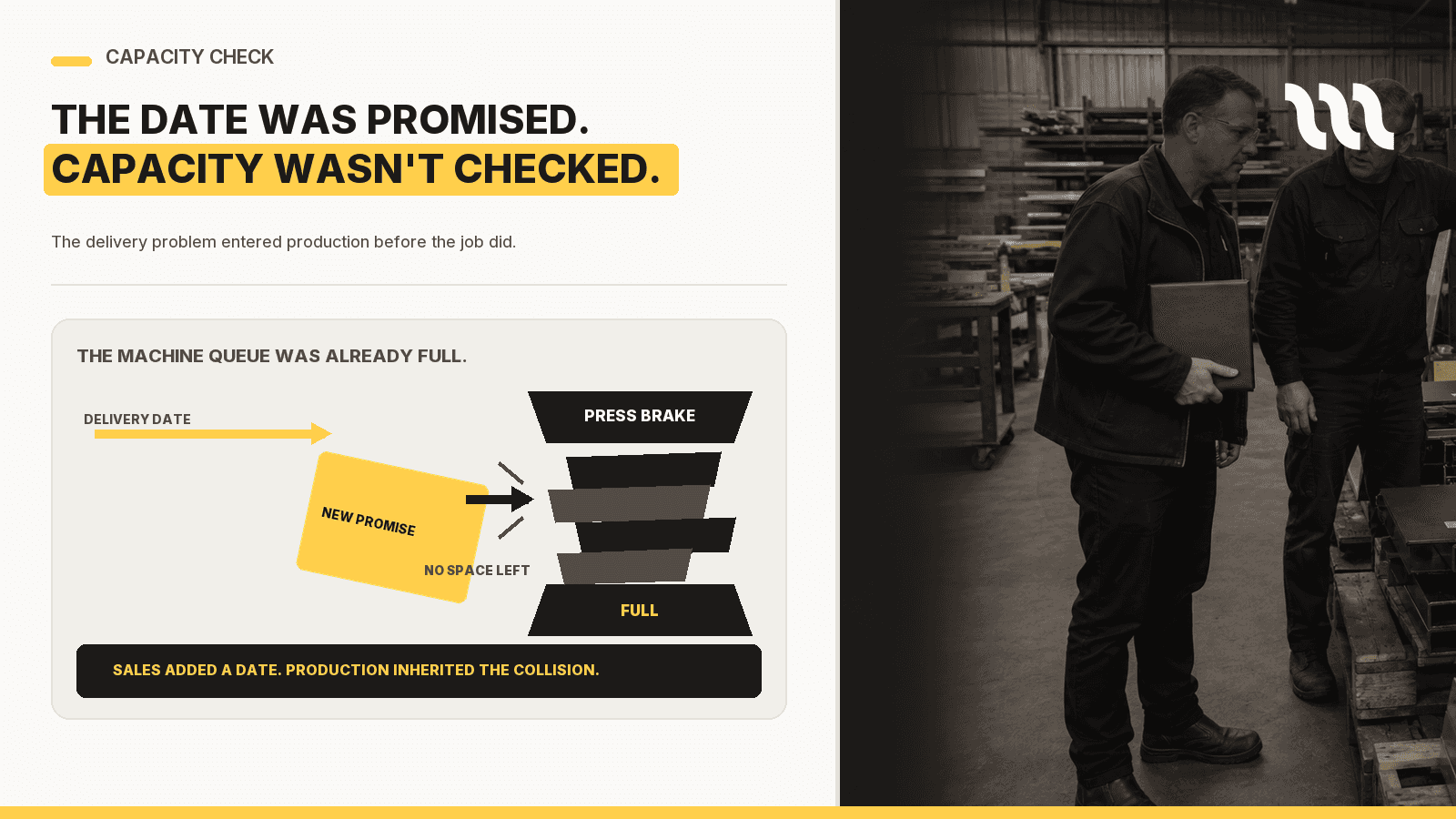
One of the most common problems in job shops is the gap between quoting and scheduling. A customer asks for a delivery date, the estimator provides one, the job is won, and only then does production realise the schedule is already full. A better process connects quoting to real capacity before promises are made.
Scheduling is also a margin issue
A poorly scheduled job can lose money even if the quote was accurate. Waiting between operations ties up cash, repeated setup increases labour cost, urgent interruptions reduce efficiency, overtime erodes margin, and underused machines waste capacity. Better scheduling protects delivery and profitability at the same time.
Practical steps to improve scheduling
Map the current process. Where does the schedule live? Who updates it? What information is missing when decisions are made? Which jobs disrupt the plan? Which machines become bottlenecks? Where does the floor get confused? Then identify the top causes of schedule breakdown and improve the feedback loop from production back to planning.
Final thought
The Friday afternoon scheduling problem is not just a planning issue. It is a systems issue. A whiteboard can show what the team intended to do, and a spreadsheet can record what someone remembered to update, but a growing fabrication shop needs a live schedule connected to real jobs, real capacity, and real shop-floor progress.
Start waitlist


How long does implementation take?
Is MirrorWorks built for custom fabrication work?
Can we move from spreadsheets gradually?
Can I see MirrorWorks in action?