
Operations
Operations
Before You Hire Another Admin, Fix the Workflow
Before You Hire Another Admin, Fix the Workflow
Before You Hire Another Admin, Fix the Workflow

By
By
By
Matthew Quigley
Matthew Quigley
Matthew Quigley
All field notes
All field notes

Before You Hire Another Admin, Fix the Workflow
At a glance
Admin work grows when information lives in too many places.
Quotes, drawings, job cards, purchase orders, schedules, production updates, invoices and customer messages must stay aligned. When they do not, people spend hours copying information, checking details and chasing updates.
Growing job shops often reach a point where the team feels stretched. But the answer is not always another admin hire.
Sometimes, the real problem is that the business has created too much admin work in the first place.
When people become the system
As job volume grows, more information must move between estimating, purchasing, production, delivery and finance.
The quote needs to match the job card. The drawing needs to be the correct revision. Materials must be ready. The schedule must reflect what is actually happening. Customers need accurate updates, and invoices need reliable production information.
When these workflows are disconnected, people become the system.
If every new job creates more chasing, copying and checking, the problem may not be headcount. It may be workflow design.
Admin is often a symptom
Hiring another person can relieve pressure, but it does not always address the cause.
If the quote does not flow into the job, someone has to re-enter it.
If the schedule is disconnected from production, someone has to ask the floor for updates.
If material readiness is hidden in emails or spreadsheets, someone has to chase suppliers.
If production data does not flow into invoicing and job costing, someone has to reconstruct the job afterwards.
That is not productive administration. It is operational friction.
The goal should be to remove that friction before adding more people to manage it.
Where admin work comes from
A disconnected job might move through the business like this:
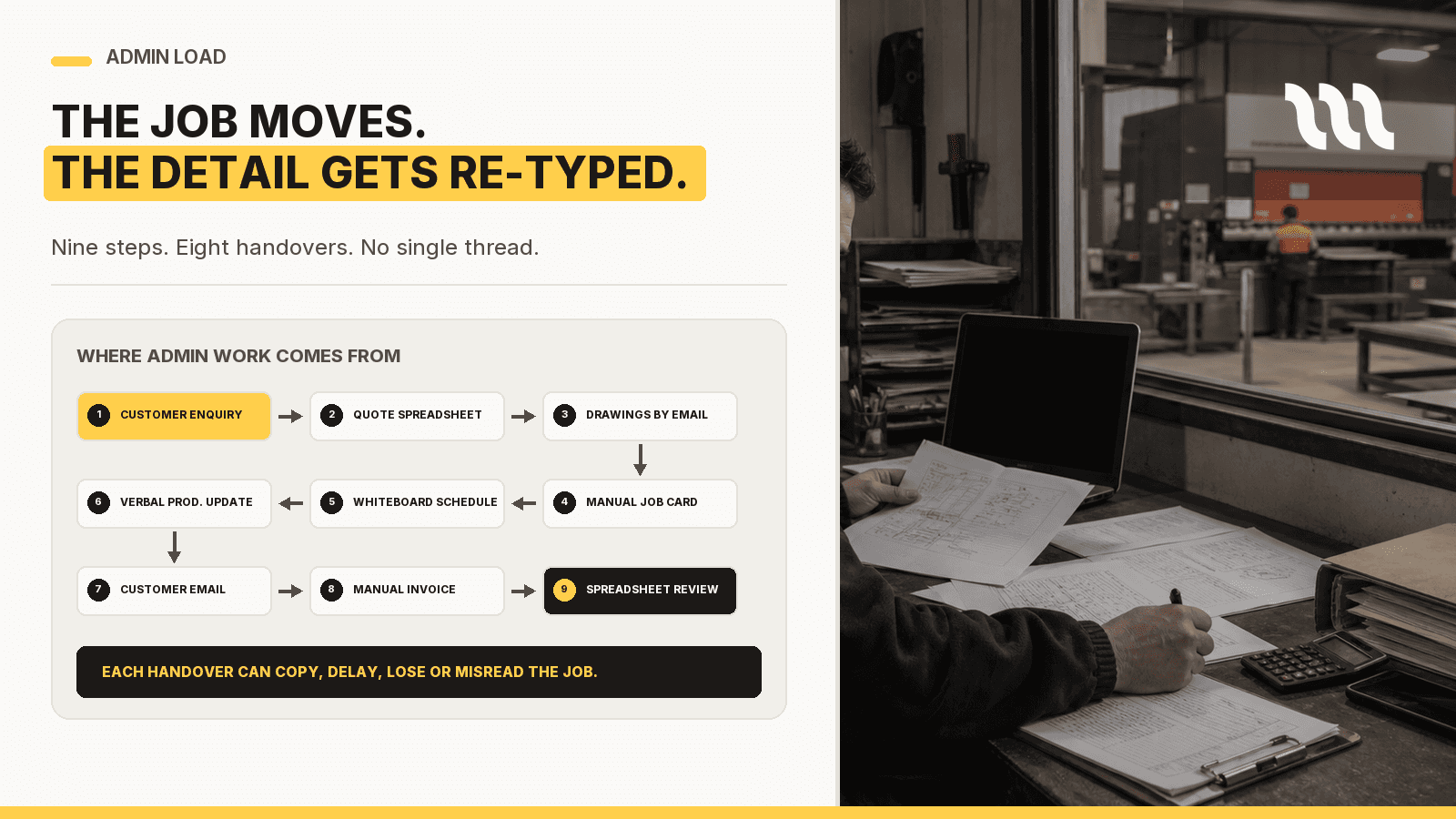
Four common admin traps
1. Quote-to-job handover
A quote is built in one system and then copied into job cards, emails and production paperwork.
When something changes, the team may not know which version is current.
2. Production status
If the only way to find out where a job is up to is to ask the supervisor or walk the floor, someone must constantly check and communicate status.
3. Purchasing and material readiness
When material availability lives in supplier emails, spreadsheets or someone’s head, jobs can be scheduled before they are ready.
4. Invoicing and job costing
If labour, rework, customer changes and outside processes are not captured during production, the office must piece the job together afterwards.
Each problem may appear small. Together, they create a significant amount of wasted time.
Are you managing work or chasing it?
Listen for the questions people repeatedly ask:
Where is that job up to?
Has the material arrived?
Which drawing revision are we using?
Who approved the change?
Can we fit this job into the schedule?
Has the job been invoiced?
Did we make money on it?
Every repeated question points to missing visibility.
If people keep asking, the system is not answering.
Better systems do more than digitise admin
There is a difference between digitising admin and reducing it.
A digital form can still create double entry. A cloud spreadsheet is still a spreadsheet. A shared folder can still contain outdated drawings. A digital schedule can still be wrong.
Reducing admin means improving how information flows:
The accepted quote becomes the job.
The job carries the correct drawings and instructions.
Material readiness is visible before production begins.
The schedule reflects real job status.
Shop-floor updates are captured while work happens.
Production information flows into invoicing and job costing.
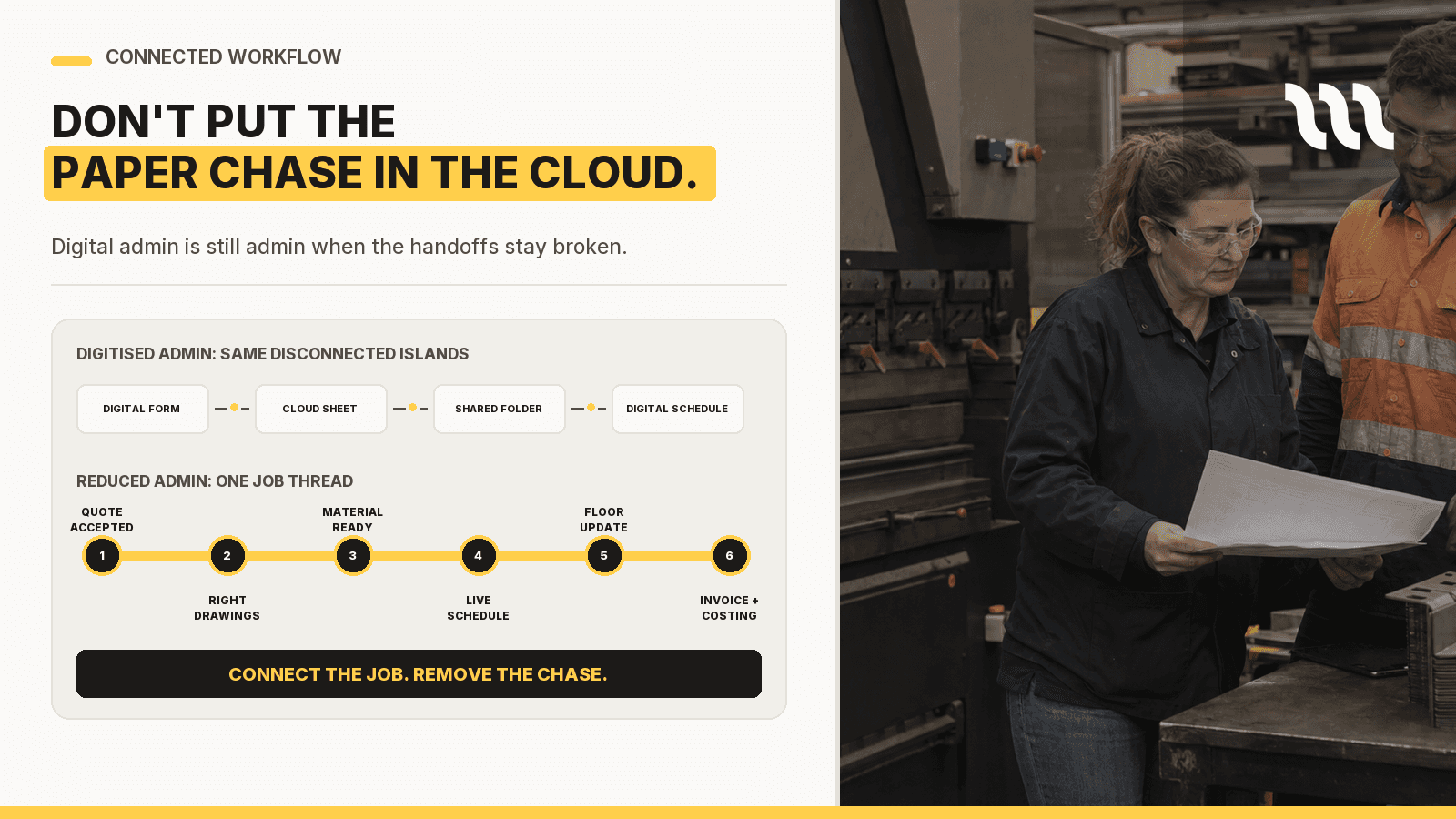
That is the difference between adding software and improving operations.
Why this matters in Australia
Australian manufacturers are under pressure to improve productivity while managing workforce constraints.
Ai Group’s Australian Industry Outlook for 2026 found that 69% of industry leaders expect to be affected by workforce shortages in 2026, slightly more than in 2025, with higher-skilled shortages proving hardest to shift. Read the Australian Industry Outlook for 2026.
The Australian Government notes that digital tools can help businesses streamline processes, track tasks, reduce errors, manage inventory and get paid faster. Read its guidance on digital tools for business.
For job shops, the test is simple: technology should reduce work, errors and delays, not create another system for people to update.
A practical way to reduce admin
1. Identify repeated chasing
Write down the questions people ask every day.
2. Find the information gap
Determine where the answer is missing, delayed, unclear or duplicated.
3. Connect the workflow
Make information move from quote to job, through production and into invoicing.
4. Capture each update once
Avoid entering the same information in multiple places.
Start with one recurring problem. If job status is unclear, improve status capture. If materials are causing delays, improve material visibility. If drawing revisions are confusing, improve document control.
This is more effective than trying to digitise everything at once.
Reduce double entry first
Double entry is one of the clearest signs of poor workflow design.
Once a quote is accepted, key information should flow into the job with minimal manual work. That can include:
Customer and job details
Drawings and revisions
Material requirements
Production routing
Due dates
Quoted assumptions
Relevant pricing information
The same principle applies when production hands a completed job back to the office.
The office should not need to chase several people to invoice the customer or understand whether the job was profitable. The necessary production information should already be available.
Admin increasing every time the shop grows?
MirrorWorks helps fabrication SMEs connect quoting, scheduling, purchasing, production and job costing so teams spend less time chasing updates and more time moving work through the shop.
Final thought
Every business needs administration, documentation and control.
But when admin grows because information is scattered, duplicated or delayed, the business is paying people to compensate for broken workflows.
Hiring more support may relieve the pressure temporarily. It does not fix the underlying system.
Reduce the chasing. Connect the workflow. Capture information once. Make job status visible. Let the quote become the job, and let production data flow back into costing and invoicing.
That is how a shop grows without adding chaos.
Before You Hire Another Admin, Fix the Workflow
At a glance
Admin work grows when information lives in too many places.
Quotes, drawings, job cards, purchase orders, schedules, production updates, invoices and customer messages must stay aligned. When they do not, people spend hours copying information, checking details and chasing updates.
Growing job shops often reach a point where the team feels stretched. But the answer is not always another admin hire.
Sometimes, the real problem is that the business has created too much admin work in the first place.
When people become the system
As job volume grows, more information must move between estimating, purchasing, production, delivery and finance.
The quote needs to match the job card. The drawing needs to be the correct revision. Materials must be ready. The schedule must reflect what is actually happening. Customers need accurate updates, and invoices need reliable production information.
When these workflows are disconnected, people become the system.
If every new job creates more chasing, copying and checking, the problem may not be headcount. It may be workflow design.
Admin is often a symptom
Hiring another person can relieve pressure, but it does not always address the cause.
If the quote does not flow into the job, someone has to re-enter it.
If the schedule is disconnected from production, someone has to ask the floor for updates.
If material readiness is hidden in emails or spreadsheets, someone has to chase suppliers.
If production data does not flow into invoicing and job costing, someone has to reconstruct the job afterwards.
That is not productive administration. It is operational friction.
The goal should be to remove that friction before adding more people to manage it.
Where admin work comes from
A disconnected job might move through the business like this:
Four common admin traps
1. Quote-to-job handover
A quote is built in one system and then copied into job cards, emails and production paperwork.
When something changes, the team may not know which version is current.
2. Production status
If the only way to find out where a job is up to is to ask the supervisor or walk the floor, someone must constantly check and communicate status.
3. Purchasing and material readiness
When material availability lives in supplier emails, spreadsheets or someone’s head, jobs can be scheduled before they are ready.
4. Invoicing and job costing
If labour, rework, customer changes and outside processes are not captured during production, the office must piece the job together afterwards.
Each problem may appear small. Together, they create a significant amount of wasted time.
Are you managing work or chasing it?
Listen for the questions people repeatedly ask:
Where is that job up to?
Has the material arrived?
Which drawing revision are we using?
Who approved the change?
Can we fit this job into the schedule?
Has the job been invoiced?
Did we make money on it?
Every repeated question points to missing visibility.
If people keep asking, the system is not answering.
Better systems do more than digitise admin
There is a difference between digitising admin and reducing it.
A digital form can still create double entry. A cloud spreadsheet is still a spreadsheet. A shared folder can still contain outdated drawings. A digital schedule can still be wrong.
Reducing admin means improving how information flows:
The accepted quote becomes the job.
The job carries the correct drawings and instructions.
Material readiness is visible before production begins.
The schedule reflects real job status.
Shop-floor updates are captured while work happens.
Production information flows into invoicing and job costing.
That is the difference between adding software and improving operations.
Why this matters in Australia
Australian manufacturers are under pressure to improve productivity while managing workforce constraints.
Ai Group’s Australian Industry Outlook for 2026 found that 69% of industry leaders expect to be affected by workforce shortages in 2026, slightly more than in 2025, with higher-skilled shortages proving hardest to shift. Read the Australian Industry Outlook for 2026.
The Australian Government notes that digital tools can help businesses streamline processes, track tasks, reduce errors, manage inventory and get paid faster. Read its guidance on digital tools for business.
For job shops, the test is simple: technology should reduce work, errors and delays, not create another system for people to update.
A practical way to reduce admin
1. Identify repeated chasing
Write down the questions people ask every day.
2. Find the information gap
Determine where the answer is missing, delayed, unclear or duplicated.
3. Connect the workflow
Make information move from quote to job, through production and into invoicing.
4. Capture each update once
Avoid entering the same information in multiple places.
Start with one recurring problem. If job status is unclear, improve status capture. If materials are causing delays, improve material visibility. If drawing revisions are confusing, improve document control.
This is more effective than trying to digitise everything at once.
Reduce double entry first
Double entry is one of the clearest signs of poor workflow design.
Once a quote is accepted, key information should flow into the job with minimal manual work. That can include:
Customer and job details
Drawings and revisions
Material requirements
Production routing
Due dates
Quoted assumptions
Relevant pricing information
The same principle applies when production hands a completed job back to the office.
The office should not need to chase several people to invoice the customer or understand whether the job was profitable. The necessary production information should already be available.
Admin increasing every time the shop grows?
MirrorWorks helps fabrication SMEs connect quoting, scheduling, purchasing, production and job costing so teams spend less time chasing updates and more time moving work through the shop.
Final thought
Every business needs administration, documentation and control.
But when admin grows because information is scattered, duplicated or delayed, the business is paying people to compensate for broken workflows.
Hiring more support may relieve the pressure temporarily. It does not fix the underlying system.
Reduce the chasing. Connect the workflow. Capture information once. Make job status visible. Let the quote become the job, and let production data flow back into costing and invoicing.
That is how a shop grows without adding chaos.
Start waitlist
Still running jobs through spreadsheets, whiteboards, and memory?
Still running jobs through spreadsheets, whiteboards, and memory?
Still running jobs through spreadsheets, whiteboards, and memory?
MirrorWorks connects quoting, scheduling, production, and job profitability in one simple system for fabrication teams.
MirrorWorks connects quoting, scheduling, production, and job profitability in one simple system for fabrication teams.

Operations
Operations
How to Move Off Spreadsheets Without Stopping the Shop
How to Move Off Spreadsheets Without Stopping the Shop
How to Move Off Spreadsheets Without Stopping the Shop

Operations
Operations
Purchase Orders That Match the Job, Not the Guess
Purchase Orders That Match the Job, Not the Guess
Purchase Orders That Match the Job, Not the Guess

Operations
Operations
Stop Typing Jobs Twice: One Record From Quote to Invoice
Stop Typing Jobs Twice: One Record From Quote to Invoice
Stop Typing Jobs Twice: One Record From Quote to Invoice

Quoting
Quoting
How to Price Welding per Metre Without Guessing
How to Price Welding per Metre Without Guessing
How to Price Welding per Metre Without Guessing
Frequently asked questions
Frequently asked questions
Frequently asked questions
Get clear answers about MirrorWorks and how it works for fabrication teams.
Get clear answers about MirrorWorks and how it works for fabrication teams.
How long does implementation take?
Is MirrorWorks built for custom fabrication work?
Can we move from spreadsheets gradually?
Can I see MirrorWorks in action?