


At a glance
Many fabrication shops start with Excel because it is flexible, familiar, and easy to adapt. The problem is not Excel itself. The problem is that spreadsheets eventually become a fragile operating system for quoting, scheduling, purchasing, production, and job costing. When the business depends on manual updates and memory to keep jobs moving, the spreadsheet has become the bottleneck.
A spreadsheet for quoting, a whiteboard for production, a folder for drawings, and a few experienced people who know what is happening can work early on. But as jobs, machines, people, rush work, and outside processes multiply, the shop grows faster than the operating system underneath it.
Excel is not the enemy. The problem starts when a spreadsheet stops supporting the operation and becomes the operation.

Excel is useful, but it was never meant to run a live factory
Excel is one of the most useful business tools ever created. It is flexible, familiar, affordable, and easy to shape around the way the business already works. For a small job shop, it can be the fastest way to organise information without buying software, hiring consultants, or changing how the team operates.
The issue starts when spreadsheets stop supporting the operation and start becoming the operation. Someone has to update the quote sheet, update the schedule, check material, tell the floor what changed, update the customer, and eventually check whether the job actually made money.
Spreadsheet-based workflow vs connected workflow
In a spreadsheet-based workflow, the quote sits in Excel, the schedule sits on a whiteboard, drawings live in folders, material status lives in someone’s inbox, and profitability is reviewed late. In a connected workflow, the quote becomes the job, the schedule updates from real job status, documents travel with the work order, material readiness is visible before production starts, and profitability is tracked as work happens.
The owner becomes the system
One of the clearest signs a shop has outgrown spreadsheets is when the owner is still the source of truth for too many daily decisions. If the team needs to ask the owner before making basic operational decisions, the business has not really built a system. It has built a dependency.
This creates a ceiling on growth. Every extra job creates more questions. Every extra person creates more coordination. Every extra customer creates more pressure. The owner becomes the integration layer between sales, estimating, purchasing, production, delivery, and finance.
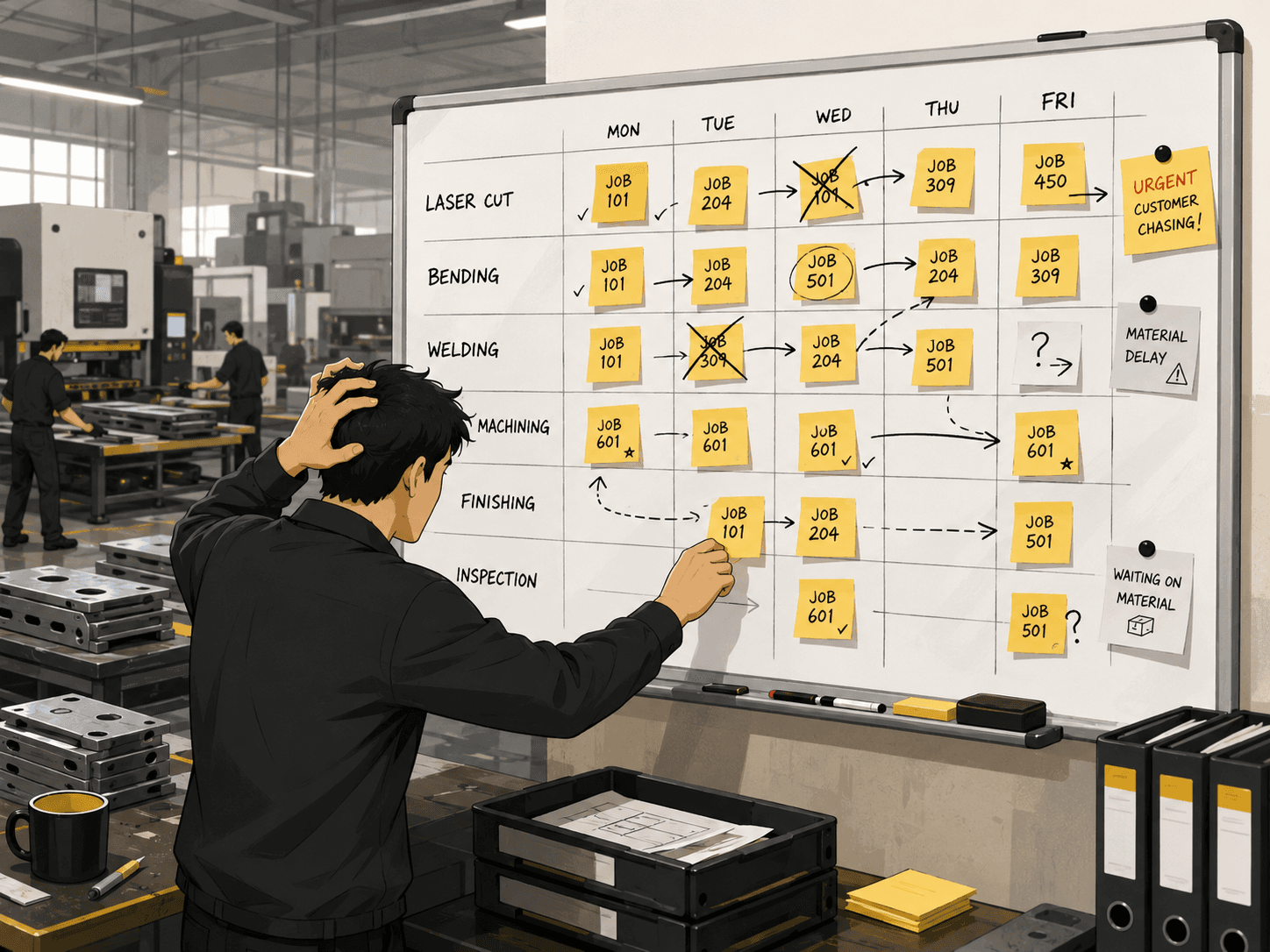
The schedule changes faster than the whiteboard
Job shop scheduling is hard because the work is variable. One job might need cutting, bending, welding, and finishing. Another might need machining and inspection. Another is waiting on material. Another is urgent because the customer is already chasing. A static schedule becomes stale quickly because the real shop keeps changing.
Quoting starts to rely too much on memory
Quoting affects revenue, margin, customer experience, and production planning. But in many shops, quoting still relies on old spreadsheets, copied templates, manual assumptions, and estimator memory. That creates speed problems and accuracy problems at the same time.
Job profitability is not visible early enough
A job can look good when it is quoted, then lose margin because of rework, extra setup time, material waste, overtime, supplier delays, unclear instructions, or outside process changes. If the business only finds this out after invoicing, it is too late to fix the job.
ERP is not always the next best step
Once spreadsheets become painful, many manufacturers assume the next step is ERP. Sometimes that is right, but for many small and mid-sized job shops, traditional ERP introduces a different problem: complexity. Replacing spreadsheets only works if the replacement is easier to use, faster to adopt, and practical enough for the floor.
Final thought
Excel helped many shops get started. But the system that gets a shop from 5 people to 20 people is rarely the system that gets it from 20 people to 50 people. MirrorWorks is built for that gap: moving fabrication SMEs beyond spreadsheets and disconnected tools into one simple system for quoting, scheduling, production, and job profitability.
Start waitlist


How long does implementation take?
Is MirrorWorks built for custom fabrication work?
Can we move from spreadsheets gradually?
Can I see MirrorWorks in action?